
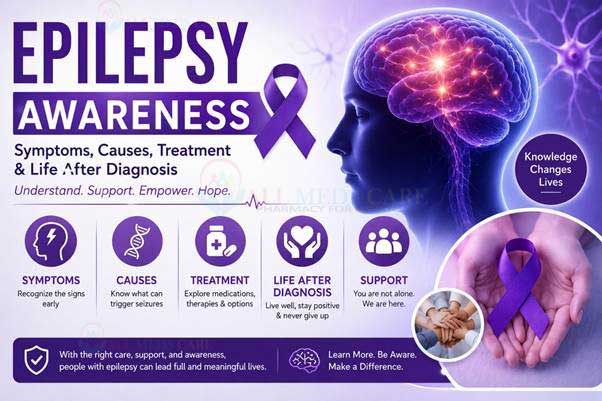
Epilepsy Awareness: Symptoms, Causes, Treatment & Life After Diagnosis
Think of waking in a hospital room with no recollection of anything. Your family appears to be concerned. A doctor comes to tell you that you have had a seizure.
This is the starting point for primary diagnosis.
Often, people are frightened, unsure and have many questions when they hear the word “epilepsy”. What caused it? Could it be the same thing that happens again? May still work, drive, travel or live alone?
Fortunately, millions of patients who suffer from epilepsy live normal, productive lives. With advances in medical care and treatment, and increased awareness, controlling epilepsy becomes more attainable than ever.
Whether you’ve recently been diagnosed or you’re providing support for someone with epilepsy, or you want to learn more about seizures, causes, treatment and living with it, there’s something for everyone.
Why Epilepsy Awareness Matters More Than Ever?
Epilepsy is not a one-time occurrence of a seizure. A condition of the nervous system lasting over time and interfering with the way the brain sends its messages (electrical signals) to itself.
The signals may go awry, leading to seizures involving movement, behavior, awareness, memory, emotions or consciousness.
The problem is, it doesn’t always present itself as people think. Others may be extremely subtle and could be confused as daydreaming, stress or simply forgetful.
More awareness leads to individuals becoming more aware of the signs at an earlier age and being able to obtain medical assistance at an early stage and to understand what to do in an epilepsy emergency.
What Exactly Is Epilepsy?
Epilepsy is a condition of the brain in which seizures happen again and again without any apparent cause.
A seizure is an interruption of the normal brain activity due to abnormal electrical activity. Many different symptoms can be produced by seizures, depending on which part of the brain it affects.
The problem is typically diagnosed if someone has two or more unprovoked seizures that cannot be explained as a result of a temporary cause (such as low blood sugar, fever, infection, etc.).
Anyone of any age, gender or background can develop epilepsy at any time.
The Early Warning Signs of Epilepsy Most People Ignore
Many people are not aware that, oftentimes, the signs of epilepsy are present for quite some time before a diagnosis is made.
Early indicators are:
- Brief staring spells
- Sudden confusion
- Memory lapses
- Unexplained fear or anxiety
- Tingling sensations
- Unusual tastes or odors
- Repetitive movements
- Loss of consciousness
- Muscle jerks during sleep
Others may have an “aura” before having a seizure. Symptoms include feeling dizzy, like you’ve seen or experienced the same thing before, changed vision, or weird sensations.
These symptoms may appear to be insignificant, and as such are frequently overlooked.
What Leads to Epilepsy in Adults and Kids?
A frequently asked question is: “Why do I have epilepsy?”
There are times when it isn’t always straightforward to get the answer right.
- Genetics: Some kinds can be passed down in families. Several genes have been identified that may be risk factors for seizures.
- Brain Injuries: The disorder can happen months or years after a fall, accident or sports injury-related traumatic brain injury.
- Stroke: Stroke is a common cause of epilepsy in older people.
- Brain Tumors: Tumors can interfere with the normal functioning of the brain and cause seizures.
- Brain Infections: Meningitis and encephalitis can cause brain damage and raise the risk of having seizures.
- Developmental Disorders: It can be a part of certain neurological and developmental disorders.
In most instances, doctors are not able to recognize the precise reason. This is known as idiopathic epilepsy.
Types of Epilepsy and Seizures Explained
All seizures are not alike.
Focal Seizures
These begin in one specific area of the brain.
Symptoms may include:
- Sudden emotional changes
- Tingling sensations
- Unusual smells or tastes
- Involuntary movements
- Temporary confusion
Generalized Seizures
These involve both sides of the brain.
Examples include:
- Tonic-clonic seizures
- Absence seizures
- Myoclonic seizures
- Atonic seizures
Some generalized seizures only last for a few moments and do not involve convulsions.
Is it possible for Epilepsy to occur later in life?
Many people think that it can only be diagnosed at a child’s age.
Adults, however, can get epilepsy at any age.
However, diagnosis has risen considerably in the elderly because of:
- Stroke
- Brain tumors
- Neurodegenerative diseases
- Head injuries
- Vascular conditions
A thorough neurological examination is necessary in a first seizure in an adult.
How Epilepsy is Diagnosed by Doctors?
The diagnosis of epilepsy is more than just a seizure.
Your doctor might use any of the following tests to diagnose your condition:
Electroencephalogram (EEG)
EEG is a test used to record the activity of the brain and identify abnormal brain activity which may be associated with a seizure.
Magnetic Resonance Imaging (MRI):
MRI scans can give detailed images of the brain and show any abnormalities in the structure of the brain.
Neurological Examination
Neurological exam assesses memory, reflexes, co-ordination and mental abilities.
Blood Tests
Blood tests can detect metabolic and other medical problems which could be involved in seizures.
Earlier diagnosis can result in better control of seizures and better quality of life.
Epilepsy Treatment Options Available Today
The good news is that many people successfully control seizures through treatment.
Anti-Seizure Medications
The use of drugs is still the first-line treatment for epilepsy.
Anti-seizure medication can be given to help control the electricity in the brain and to reduce the number of seizures.
Gabapentin is used in one medication called Gabatop Capsule that may be prescribed for some seizure disorders. Gabapentin is a type of medication called an anticonvulsant that can be used to treat abnormal electrical activity that may be linked to a seizure.
Gabatop is also used often to treat some types of nerve pain. Always take medication as prescribed and never change medication without consulting your health care provider.
Surgical Treatment
Surgery can be considered if a person’s seizures are not controlled by medicines.
The aim is to eliminate or modify the part of the brain that causes seizures without disrupting other brain functions.
Neuromodulation Devices
Advanced technologies may be useful in reducing the frequency of seizures by stimulating specific nerves or areas of the brain.
Lifestyle Management
Medicines can be important in controlling seizures, but lifestyle is also important.
Helpful habits include:
- Maintaining regular sleep schedules
- Managing stress
- Avoiding alcohol when advised
- Following medication schedules carefully
- Attending routine medical appointments
Do’s and don’ts for When Someone Is Having a Seizure
Seizure First Aid can save lives.
When someone is having a seizure:
- Stay calm.
- Move dangerous objects away.
- Protect their head with something soft.
- Turn them gently onto their side.
- Time the seizure.
- Stay with them until recovery.
Never:
- Hold the person down.
- Put objects in their mouth.
- Force food or water into their mouth.
Seek emergency medical assistance if:
- The seizure lasts longer than five minutes.
- Another seizure immediately follows.
- Breathing difficulties occur.
- Serious injury occurs.
The Following Are Some Common Myths About Epilepsy That Need to End
Here are some common myths about epilepsy and why they are wrong.
Myth: Epilepsy is a mental illness.
Fact: Epilepsy is a disorder of the brain where there is abnormal activity.
Myth: People with epilepsy can’t work or study.
Fact: Many people with epilepsy who have successful careers, college degrees, and independent lifestyles.
Myth: It’s possible to swallow the tongue during a seizure.
Fact: It’s not physically possible.
Myth: All seizures are convulsions.
Fact: Seizures often include staring spells, confusion or slight changes in behavior.
Life After Diagnosis: Can Epilepsy Patients Live Normal Life?
A diagnosis may be a frightening experience.
Many patients initially worry about:
- Employment
- Driving
- Independence
- Relationships
- Future health
In fact, a large number of people with epilepsy have full and productive lives.
Today’s drugs, better diagnosis and more awareness have made a huge difference in the results.
Following an initial period of seizures, with the appropriate treatment and support, many people can reach a state of long-term seizure control and continue to work and live their lives as they would like.
Healthcare providers, family, employers and community organizations can help to make a difference.
The Future of Epilepsy Treatment
There are ongoing innovations in the treatment of epilepsy.
Some areas where there is current innovation are:
- Precision medicine
- Advanced brain imaging
- Genetic testing
- Artificial intelligence-assisted diagnosis
- Improved neuromodulation devices
- Novel anti-seizure medications
The progress is all very encouraging for millions of people with epilepsy who are keen to help control their seizures more effectively and live happier lives.