
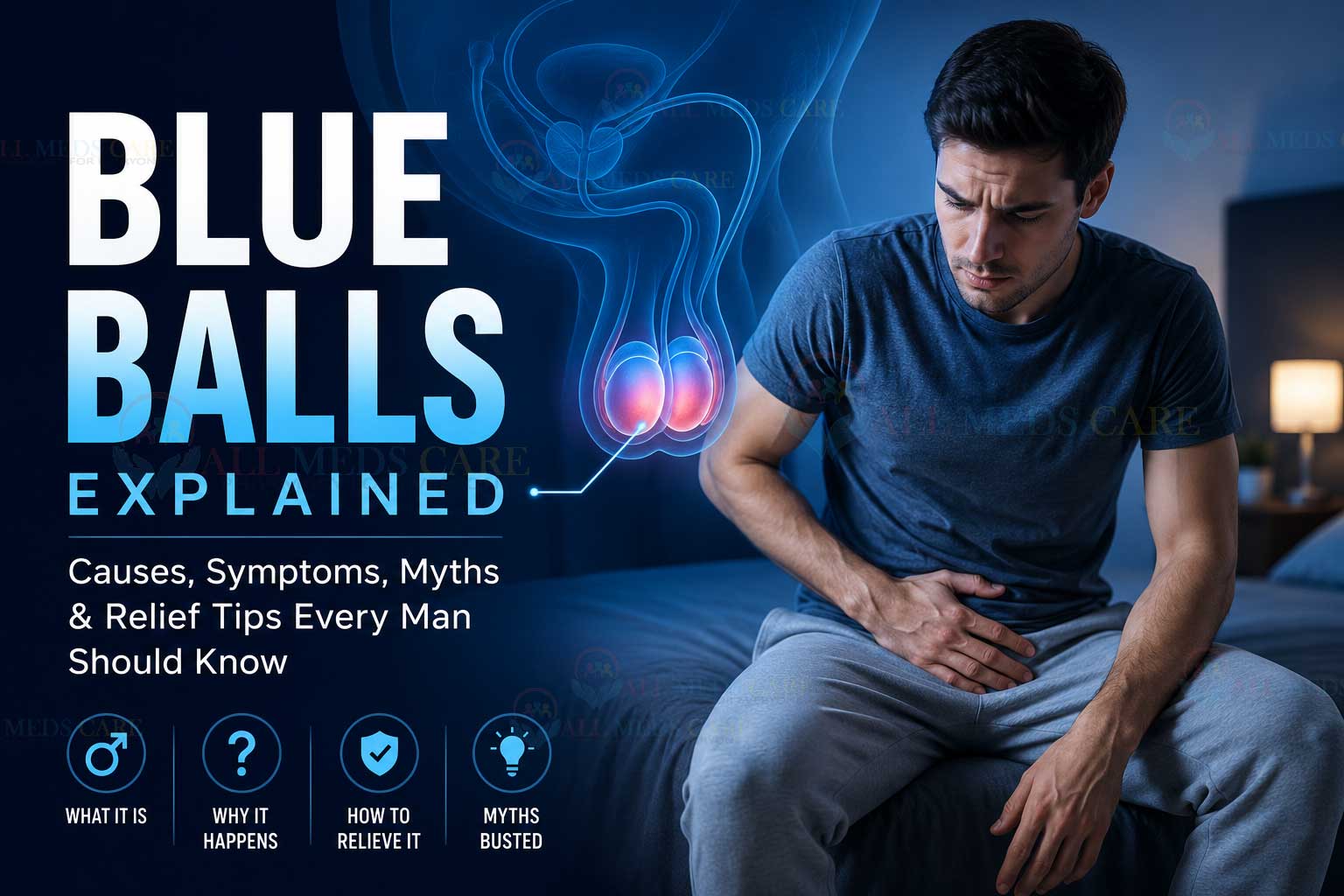
Why Do My Testicles Hurt After Not Ejaculating? Is it Blue Balls

Hurting Testicles? To be very Honest! There’s hardly any condition in men’s health that is surrounded by as many jokes, myths and embarrassing conversations as “Blue Balls”.
Some people claim that this condition doesn’t even exist. At the same time, some say that every man suffers from it. Many men experience pain in their testicles after having sexual arousal and not ejaculating and have no idea what is going on in their bodies.
So, who is correct?
The answer is… everyone to a certain extent—but mostly, none of them.
Blue balls actually exist but not in the way the movies, social media, and discussions in locker rooms usually portray them.
“Your testicles do not go blue”
They do not burst if you do not have an orgasm.
They are not damaged permanently.
And they are definitely not a health emergency that needs immediate medical attention.
However, despite the myths, there is a real physiological reason why some men experience discomfort or pain in the testicles for some time after being sexually aroused for a long time.
Let’s uncover the truth on hurting testicles.
First Things First… Do Blue Balls Actually Exist?
Yes.
While it is a certain term in the medical community, the condition referred to as blue balls causes discomfort.
This medical condition is known as epididymal hypertension.
Don’t let the fancy name scare you.
It simply refers to temporary discomfort experienced by men when they experience sexual arousal for a long time without reaching orgasm.
- Not every man goes through this condition.
- Some may never encounter it in their lifetime.
- Others may go through it at times.
It is important to remember that just because your neighbour says he suffers from blue balls doesn’t necessarily mean that you will.
Why Are They Even Called “Blue Balls”?
This is perhaps the most popular misapprehension. Although called… The testicles are fairly unlikely to change to blue in colour.
It seems the word gained popularity thanks to the fact that extended sexual arousal is believed to cause slight pressure and blood flow in the genital area, which gives rise to the opinion that the testicles change colour.
However, this is not the case for the majority of men. The expression made its way into everyday speech.
What’s Actually Happening Inside Your Body?
The concept of blue balls can be understood as the body’s preparation for sexual intercourse.
The following processes happen in the body during sexual arousal:
- Increased blood flow to the penis
- Increased blood flow to the testicles
- Expanding blood vessels
- Activating muscles in the pelvis All of the above is entirely normal.
Usually, after an orgasm, the body returns to its normal state. But if the orgasm does not occur, the increased blood flow slowly goes back to its normal state and doesn’t go away immediately.
What some men experience is that they feel discomfort in the area of the testicles – this is known as blue balls.
So… What Do Blue Balls Actually Feel Like?
If you consult ten distinct men, you’re likely to receive ten distinct evaluations.
The typical sensations may be as follows:
- Painful distress in one or both testes
- Feeling of fullness in the scrotum
- Light pulsation
- Sensation of pressure in the groin area
- Short-term sensitivity
- Feeling of tension
- Some guys may not feel anything at all.
Others may be so distressed that they start searching online as soon as they feel something is wrong. What is worth knowing is that the feeling of discomfort is usually short-lived.
Unlike sudden injuries, the discomfort usually develops gradually.
It often begins shortly after prolonged sexual arousal and slowly fades as the body returns to its resting state.
For many men, it’s more annoying than painful.
For others, it can be surprisingly uncomfortable—but it’s usually temporary.
And here’s something that often catches people off guard…
The discomfort doesn’t always stay in the testicles.
Sometimes, it seems to travel elsewhere.
Could that explain why some men report stomach pain?
That’s exactly what we’ll explore next.
How Long Do Blue Balls Last?
Luckily, blue balls tend to be temporary. When it comes to the majority of men, the discomfort will generally go away within around twenty minutes to an hour after sexual arousal has ended.
However, other men may find that the ache lasts longer, especially when they have been aroused for a prolonged period or have been edging.
If the pain lasts for several hours, increases in intensity, and returns without obvious sexual arousal, it is not something that you should associate with blue balls.
In these cases, one should think about other potential causes and seek medical help if needed.
How to Deal with Blue Balls (What Actually Helps?)
Allow Your Body to Heal
In some cases, the best medicine is time. Once the body has had time to return to its normal resting state, blood circulation reduces, muscles become relaxed and discomfort usually just passes by itself. Waiting may be enough for most men.
Achieve Orgasm If You Feel Like It
If the man is willing to, the solution could be ejaculation, either during masturbation or through intercourse. The orgasm is part of the natural sexual response cycle. When considering ejaculation, it is necessary to clarify that it is not needed.
Go for a Walk
Performing light or low-level physical activities can be beneficial for two main reasons. First of all, they will distract the body from sexual arousal. Secondly, any minor exercises will help with less pressure. It is worth mentioning that there is no need to work out hard.
Undergo a Cool Shower
A refreshing shower can be very helpful in decreasing any sensation of arousal. There is no need to depend on iced water; the objective is to feel pleasant and appealing rather than shocked.
Stay Distracted
If you continue to think of that sensual occurrence which made you feel aroused, your body will continue to be stimulated for a longer time than required. One can watch a movie, read a book, get chores done, or simply concentrate on work to make the body return to the resting state on its own.
Put On Supportive Undergarments
If you suffer from swollen testicles or even quite heavy ones, some support in the form of undergarments will make it possible for you to experience less pain while awaiting the moment for discomfort to vanish.
What You Shouldn’t Do
Blue balls were associated with many harmful myths throughout history.
Follow these rules:
Do not panic: Blue balls are generally harmless and temporary.
Do not think that you have to ejaculate immediately. The pain will usually go away on its own.
Do not let yourself or anyone else pressure you into doing anything sexual. Nobody is required to have sex simply because someone says they have blue balls.
Do not ignore serious pain: If the pain is severe, prolonged, or associated with swelling, tenderness, fever, or nausea, visit a doctor instead of believing it is blue balls.
When Is It NOT Blue Balls?
Even though blue balls usually don’t threaten men’s health, it does not mean that men should treat every occurrence of testicular pain as blue balls.
Various medical conditions can cause pain in the testicles and should be treated by a doctor immediately.
You should go to a doctor if you experience the following symptoms:
- Severe sharp pain in one testicle
- Extensive swelling or redness of the scrotum
- One of the testicles suddenly becomes much higher than the other
- Fever or Chills
- Nausea or vomiting
- Visible lump in the testicle
- Pain lasts for hours after an event
All of the above symptoms can have the following reasons:
- Testicular torsion (very dangerous condition that interrupts blood supply to the testicle)
- Epididymitis (inflammation, sometimes caused by an infection)
- Orchitis (inflammation of the testicle)
- Inguinal hernia Kidney stones can also cause pain in the groin.
It is better to be checked by a doctor instead of self-diagnosis.
10 Common Myths About Blue Balls—Busted
Myth #1: Blue Balls Aren’t Real
The Truth: They Are Not. Although blue balls is not a medical term, doctors know that men can suffer from some pain in their testicles after they have been sexually aroused without coming. This condition has been termed “Epididymal Hypertension“.
Myth #2: Your Testicles Turn Blue
The Truth: Not Really. The term blue balls is not a medical term. While increased blood circulation may change the skin, the testicles do not change colour.
Myth #3: You Can Get Blue Balls Because of Not Having Sex
The Truth: Sexual intercourse is not necessary for you to have blue balls. Blue balls are linked to prolonged sexual arousal. Regardless of the situation, regardless of whether you are kissing someone, or doing foreplay, or having intimate contact, or fantasizing, or having sex over the phone or video call, prolonged sexual arousal can cause blue balls.
Myth #4: Blue Balls Are Always Caused by Edging
Fact: That is not always the case. Edging is the act of bringing oneself close to orgasm only to stop. Edging can, in theory, prolong the state of sexual arousal for longer periods of time which could lead to some men experiencing discomfort.
However, most of the people who edge will never face blue balls. Like many things regarding sexual health, everybody reacts differently.
Myth #5: Blue Balls are Caused by the Accumulation of Sperm
Fact: That is one of the oldest sexuality myths. Sperm production happens all the time in men regardless of whether ejaculation occurs or not. In the absence of ejaculation, the body breaks down and absorbs the sperm.
Blue balls do not occur because of excessive sperm accumulation in the body, but due to increased blood supply and pressure.
Myth #6: All Men Experience Blue Balls
Fact: Certainly not. Some men experience blue balls while others do not.
Myth #7: Blue Balls Lead to Infertility
Fact: There is no evidence for this. According to modern medical knowledge, blue balls do not lead to lower sperm counts, infertility problems, erectile dysfunction, or permanent damage to the testicles.
Myth #8: You Have to Orgasm Right Away
Fact: The release is helpful, but not necessary. Some men may need to relieve themselves through sex or masturbation to eliminate discomfort, whereas blue balls usually go away by themselves. Sometimes just waiting until your body goes back to normal is enough.
Myth #9: Your Partner Has to Help You “Fix”
It Fact: Absolutely not. This is one of the most dangerous myths relating to blue balls. There is no obligation for the partner to have sex just because you say you have blue balls.
Myth #10: Blue Balls Are Always Harmless
Fact: Usually true but not always. Often, blue balls will resolve themselves, but any sudden or severe pain in the testicular area should not be ignored.
If you experience extreme pain, swelling, redness, fever, nausea, vomiting, and one testicle sitting higher than the other, go to a hospital right away, as these could be the symptoms of either testicular torsion or an infection that requires immediate attention.

About John Davis
Healthcare Writer & Medical Content Author
John Davis is a content creator in healthcare with a career at AllMedsCare that consists of writing articles with knowledge for patients on pharmaceutical topics, health issues related to men and women’s health, sexual health during pregnancy, procedures, exercising, and... Read More
View all posts by John Davis


