
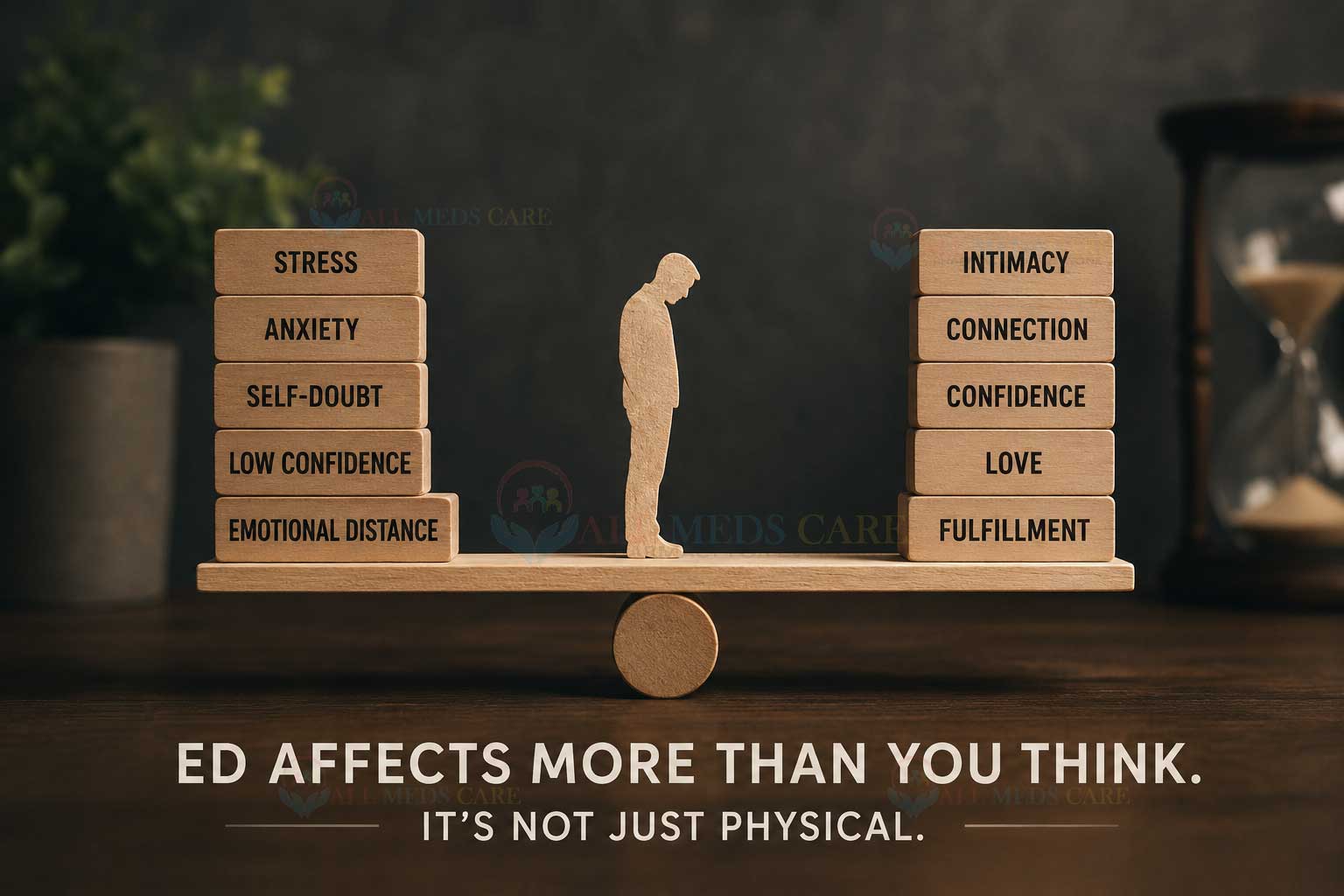
What Emotional Effects of Erectile Dysfunction Do to Men With Erectile Dysfunction?
When people think about erectile dysfunction (ED), the conversation almost always revolves around one thing: physical performance.
Can a man get an erection?
Can he maintain it?
What treatment options are available?
All of these are very important things to talk about, but they only scratch the surface of a much deeper issue that many men are living with every day. What happens when ED begins to affect not just a man’s sexual performance, but also his ability to be intimate and confident with his partner and connected emotionally?
The answer for that is sexual deprivation.
When we think of being sexually deprived, we often think of not having intercourse. But sexual deprivation may be much more complicated than that. For example, a man in a loving relationship may still feel drawn to his partner and have the desire to make love with them, yet still feel very disconnected from that aspect of his life due to the emotional and psychological burdens that ED creates.
And that’s where the conversation may prove useful and relevant to the millions of men currently living with ED.
The Difference Between Having Desire and Feeling Able to Act on It
A common misperception about erectile issues is that men lose desire for sexual activity after experiencing them.
The truth, however, is most men continue to achieve healthy levels of sexual desire or libido, wish to experience emotional closeness with their intimate partners, find them physically attractive and want to spend time together physically.
The impediment to achieving their desires is very often self-confidence.
Men will often change their spontaneous approach toward intimacy as their emotional confidence wanes due to their past sexual encounters. They will start to worry about having intimacy instead of looking forward to it, there will no longer be the thrill associated with being intimate with their partners, but rather they feel as if they are under pressure to perform.
The anticipation of experiencing failure (not being able to get an erection or not achieving orgasm) is much greater than any desire for intimacy.
These feelings of apprehension often serve as an initial indicator that a person will begin to exhibit sexual deprivation. This is not because of a lack of desire to have intimacy with their partner, but rather an indication of the emotional risk that intimacy represents.
The Emotional Effects of Erectile Dysfunction Reach Far Beyond the Bedroom
The physical symptoms of ED may be visible, but the emotional consequences often remain hidden.
Many men experience ED as a psychological trouble that flows in their head throughout their day, even if sexual activity isn’t on their minds.
The emotional effects of erectile dysfunction are frequently carried into how a man sees himself.
Men often begin to have questions about themselves:
- Am I letting my partner down?
- Will this happen again?
- Is something wrong with me?
- What does my partner think?
These questions may appear to be benign at first; however, they become persistent worries, which may eventually erode confidence and self-worth.
The emotional effects of erectile dysfunction can consist of feelings of embarrassment, frustration, anxiety, guilt, and social isolation. Many men will withdraw from social interactions, while others will throw themselves into their work or another distraction to escape reality.
What complicates the emotional impact for many men is that they do not share their feelings regarding ED, letting their thoughts about ED grow gradually and consistently.
“I Still Want Intimacy… So Why Am I Avoiding It?”
This is probably one of the hardest things for men who suffer from erectile dysfunction to understand.
On one hand, there is a continuing desire for intimacy.
On the other hand, there are times when they are avoiding anything that could lead to an intimate encounter.
From a common sense point of view, this makes no sense.
Why would someone want something so much but then avoid it?
The answer is generally rooted in self-protection.
When you continually place yourself in a situation where you are repeatedly experiencing disappointment or anxiety, your brain will eventually develop an association of that situation to be stressful rather than pleasure.
For many men, they find that over time, intimacy goes from a way to connect with someone to becoming the cause of stress.
Because of this many men:
- Stop initiating sexual activity.
- Avoid any romantic scenarios.
- Decrease their level of physical affection with another person.
- Alter their sleeping patterns.
Find excuses while keeping busy to avoid being in situations where intimacy may take place.
The reasons for this avoidance are rarely due to a lack of physical attraction to the person, but are geared towards the person’s attempt to avoid feeling any emotional discomfort.
Unfortunately when someone is looking to protect their self-confidence in the short term, it will only create a greater overall problem in the future.
When Erectile Dysfunction and Relationships Start Moving in Different Directions?

Erectile dysfunction (ED) does not occur in an isolated environment. Although ED is a personal condition affecting men individually, it has an impact on the relationship as well.
The connection between erectile dysfunction and relationships is often forgotten or downplayed as ED is a physical condition, whereas the repercussions from ED are emotional in nature.
A man suffering from ED can often identify the reasons why he is pulling away from his partner; however his partner may not understand that his pulling away is due to his erectile problems.
Also, with no open dialogue regarding intimacy between partners, there can be a lot of misunderstanding between couples.
For example, the partner might believe:
- He is not attracted to me anymore.
- He is no longer interested in our relationship.
- He is avoiding me.
However, the man suffering from ED may be trying to avoid another disappointing situation for himself.
Neither one in the relationship knows the whole picture.
This is the reason why erectile dysfunction and relationships become complex. ED creates a physical issue between the partners, which causes emotional beliefs that neither partner ever intended.
The Quiet Rise of Erectile Dysfunction Relationship Problems
Most relationship challenges don’t begin with dramatic arguments or major conflicts.
They often begin with small differences that build over time.
A missed opportune moment for intimacy.
A conversation that never takes place.
An affectionate gesture becomes less frequent.
As time goes by, when ED is unresolved, these small moments can ultimately create substantial problems between partners.
The examples listed below demonstrate a few common examples of erectile dysfunction relationship problems:
- Reduced emotional closeness
- Increased tension
- Miscommunication
- Feelings of rejection
- Frustration on both sides
Interestingly, in many cases, the problems listed above were not caused by ED itself.
Rather, each of these issues was triggered or caused by how one partner emotionally or behaviorally reacts to having Erectile Dysfunction.
The condition is the challenge; however, the significance of the challenge is worsened because silence about it creates a larger one.
This supports the idea that when treating erectile dysfunction relationship problems, support must be provided to address issues related to both the physical symptoms and how these physical symptoms are affecting the relationship as a whole.
The Psychological Effects of Erectile Dysfunction Can Create a Cycle
One of the hardest parts of erectile dysfunction is that it can have a snowball effect on itself.
A man has trouble getting an erection.
He loses confidence in himself.
He becomes anxious.
He may feel more pressured while being intimate with his partner.
He is subjected to additional stress that causes further difficulty in getting an erection.
His confidence decreases once again.
And the cycle goes on.
This pattern demonstrates how the psychological effects of erectile dysfunction should not be overlooked.
The mind has a tremendous influence on sexual performance. When anxiety, fear, and lack of self-esteem become associated with intimacy, even the smallest issue can affect future experiences in a major way.
Psychological effects of erectile dysfunction include:
- Performance anxiety
- Reduced confidence
- Fear of intimacy
- Increased stress
- Negative self-perception
The longer this cycle continues, the more entrenched it will become.
Fortunately, understanding this cycle is often the first step to breaking it.
How Erectile Dysfunction and Marriage Can Change Over Time?
Marriage creates a new setting for erectile dysfunction.
For many couples, years of emotional attachment, daily schedules, mutual expectations, and shared history lead to erectile dysfunction and marriage developing at a slower pace than when they were in a new relationship.
Many couples will adapt to their situation in ways they may not recognize right away.
Going out on dates becomes less frequent.
Physical affection decreases.
Talking about intimacy begins to feel awkward.
The months go by.
Then the years go by.
Eventually, both partners can feel they are disconnected from one another, and neither will have a complete understanding of why it is happening.
Fortunately, many couples experiencing issues due to erectile dysfunction and marriage discover that communicating honestly with one another has significantly improved understanding and intimacy between them.
While not all issues can be resolved immediately, many couples will find that open and honest conversation will allow them to make meaningful steps toward resolving their issues.
Why Sexual Deprivation Is About More Than Intercourse?
The phrase “sexual deprivation” can sometimes create the wrong impression.
People often assume it refers solely to the absence of sexual activity.
For many men who have erectile dysfunction, the answer is much more complex.
Although they may want to get physically intimate, they also miss:
- Feeling desired
- Feeling confident
- Feeling connected
- Feeling spontaneous
- Feeling close to their partner
Thus, sexual deprivation can be experienced more emotionally before it is felt physically.
This can make the lack of intimacy act as a reminder of the confidence and connection that have been disrupted by erectile dysfunction.
Finding a Path Forward Along With ED Medications
When you hear about Erectile Dysfunction, the focus is nearly always on either taking medications or getting some medical procedure completed.
Although the medications and procedures can be effective, they represent just one part of the entire healing process.
Improving the quality of one’s lifestyle, learning how to manage the stress of dealing with erection issues, exercising good open communication, and receiving emotional support from others all play crucial roles in helping a man to regain confidence and rebuild intimacy.
Healthcare providers may also suggest certain reliable medication treatments, for example, sildenafil citrate based medications such as Cenforce 100mg, Kamagra 100mg, Caverta 100mg, Aurogra 100mg, etc. for men in cases when it is appropriate. However, the treatment may work optimally when you take the holistic view and don’t consider it as a stand-alone solution.
Furthermore, restoring an individual’s level of intimacy implies rebuilding their self-confidence as well as rebuilding their ability to connect with other individuals.
What Gets Lost Along the Way: The Cause Of Emotional Effects of Erectile Dysfunction?
Most people’s conversations surrounding erectile dysfunction begin with erections.
However, for most men, the real struggle often has less to do with erections but rather with their loss of confidence, connection, and emotional closeness to others due to erectile dysfunction.
Understanding the emotional effects of erectile dysfunction, recognizing how erectile dysfunction and relationships influence one another, addressing erectile dysfunction relationship problems, acknowledging the impact of erectile dysfunction and marriage, and confronting the often-overlooked psychological effects of erectile dysfunction can provide a much clearer picture of what many men are truly experiencing.
Sexual deprivation may not always be solely the lack of sexual activity.
Sexual deprivation can also be due to an individual’s lack of sexual confidence.
Sometimes it can also be a fear of rejection.

Rebuilding intimacy in those suffering from erectile dysfunction
In addition, some men may feel that they have lost touch with a part of themselves.
These experiences do not have to determine the future. Through understanding, communication, help, or support with intimacy rebuilding, men dealing with erection problems can rebuild intimacy that has a greater potential for a strong and honest connection with their partner than what existed prior to experiencing erectile dysfunction.